How to Clean an Automatic Cat Feeder (and Keep the Water Fresh Too)
By Dennis Ng, Founder of ONYEABLUZ
A quick wipe is not enough. The hopper, chute and pump need a proper clean on a schedule.
Your feeder looks clean. That is the trap. Kibble leaves a fine, oily dust every time it tumbles down the chute. It sticks to the hopper walls, goes stale, and turns tacky. Then it grabs the next round of dust. Give it a few weeks and the chute narrows, portions get uneven, and one day the motor turns and nothing comes out. The bowl has its own problem. Saliva, food bits and water make a slimy film, and that film is not dirt. It is biofilm, a layer of bacteria that clings to wet surfaces and shrugs off a quick rinse. This is a fifteen minute job once you know the routine, and it keeps the feeder working the way it should.
The short answer
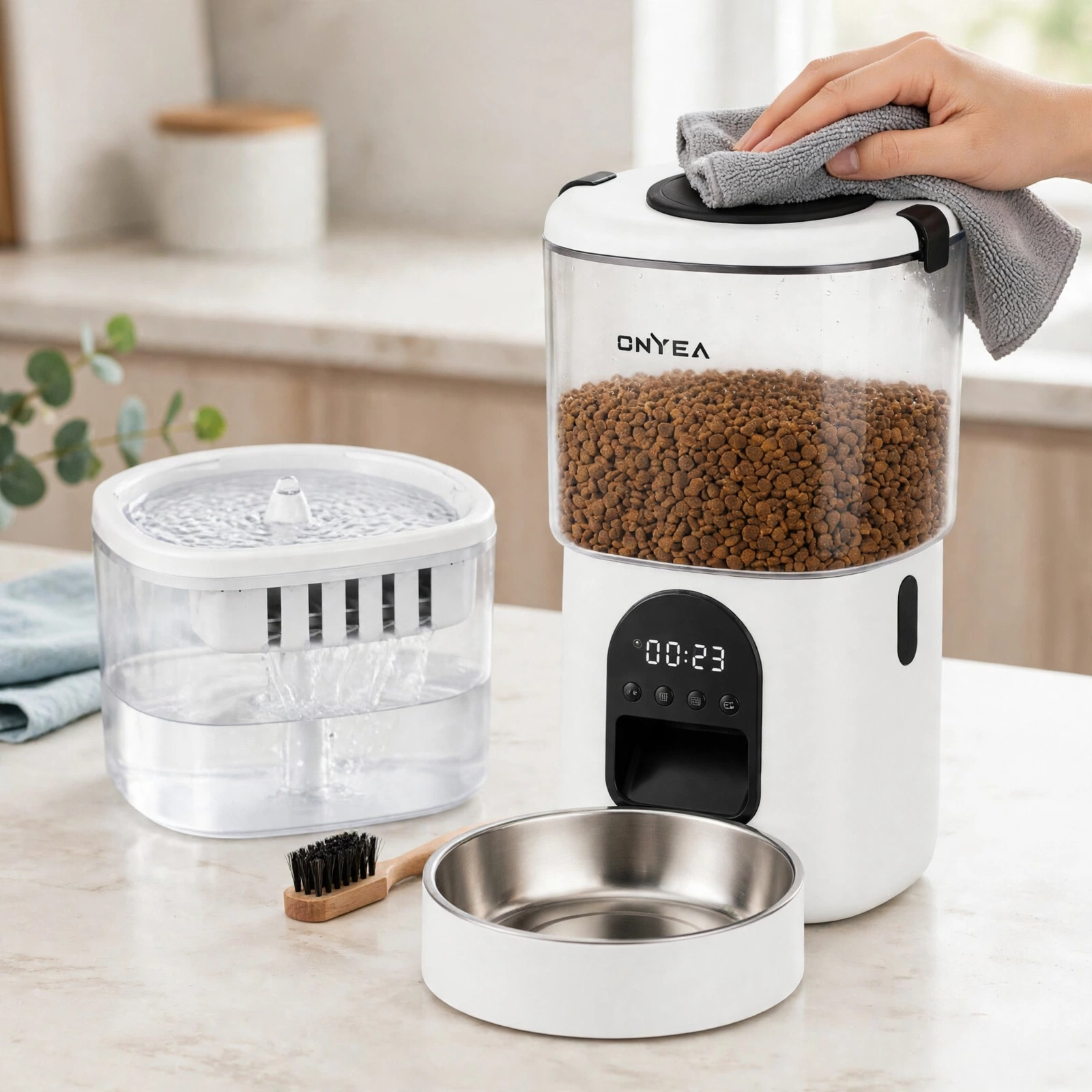
Wash the bowl every day or two. Brush out the chute once a week. Take the feeder apart and wash the removable parts every one to two weeks. If your feeder has a water reservoir or you run a fountain beside it, rinse the water side every one to two days and take the pump apart at every full clean. Always check your own manual first. It wins over any general guide, including this one.
What you need
- Warm water and a little plain, unscented dish soap
- A soft sponge or cloth
- A small bottle brush or an old soft toothbrush for the chute and corners
- A clean towel or a drying rack
- White vinegar, for mineral scale in hard water areas
Skip abrasive pads and sharp tools. They scratch plastic, and those scratches give biofilm somewhere to hold on.
Step 1: Unplug it and empty it
Turn the feeder off and unplug it. Take the batteries out too if it has them, so it cannot start dispensing while your hands are inside. Pour the leftover kibble into a sealed container. If it smells stale or greasy, throw it out. Do not pour old food back in after cleaning.
Step 2: Take apart what the manual lets you take apart
Most feeders come apart into a hopper, a lid, a bowl and sometimes a chute insert. Follow the manual and do not force a latch. The base holds the motor and the electronics. It never goes under water. Wipe it with a dry or barely damp cloth only.
Step 3: Brush the chute dry first
Before any water touches it, sweep the chute and the hopper corners with a dry brush. Kibble dust turns to paste when it gets wet, and paste is much harder to shift. This dry pass is the step most people skip, and it is the one that stops jams.
Step 4: Wash the removable parts
Wash the bowl, hopper, lid and any removable chute parts in warm soapy water. Rinse twice. Soap residue tastes bitter, and some cats will refuse a bowl that still smells of soap. The FDA recommends washing pet food bowls and scoops with soap and hot water after each use, and that is a good standard for the feeder bowl too.
Step 5: Dry everything completely
Air dry every part until there is no moisture left, including inside seams and corners. Stand pieces upside down on a towel if you can. Any trapped water becomes the start of the next film, and damp kibble clumps and spoils. Do not refill the hopper until it is bone dry.
Step 6: Reassemble and test
Put it back together, refill with fresh food, plug it in and run a manual feed. Check the schedule and portion settings are still right. A test meal at home beats finding out the hard way while you are out.
The water side: why the slime keeps coming back
If your feeder has a water reservoir, or you run a cat fountain next to it, the same rule applies, only faster. The slime is biofilm again. It comes back in days when the one part people skip, the pump and its impeller, still holds a colony. The bowl can look spotless while the pump housing reseeds the whole fountain as soon as the water flows.
Rinse and refill the water every one to two days. Do a full teardown about once a week, sooner with several cats. Take the pump apart every time: faceplate off, impeller out, brush the housing and the little tube the impeller sits in. Swap the carbon filter every two to four weeks, or when your model says so. A clogged filter slows the flow and stops doing its job. In hard water areas, soak the non-electrical parts in a one to one mix of white vinegar and water for fifteen to twenty minutes once a month, then rinse well. That clears the white scale that makes pumps noisy.
One honest baseline: a bowl rinse every day or two plus a full clean somewhere between weekly and every two weeks is normal fountain ownership, whatever the fountain is made of. If you are cleaning that often and the slime still wins, the pump is the place to look first.
A simple schedule to stick on the fridge
- Daily: quick check of the bowl and chute for stuck food, wipe up spills.
- Every day or two: wash the bowl, rinse and refill the water.
- Weekly: brush the chute, wash removable parts, take the pump apart if you have a fountain.
- Every one to two weeks: full teardown wash of the feeder.
- Every two to four weeks: change the filter, check seals and the battery compartment.
- Monthly: vinegar soak for scale in hard water homes.
Signs it needs a clean now, not next week
- Portions look smaller than usual, or the feeder runs and nothing comes out.
- A stale or greasy smell from the hopper, or kibble that looks dusty and old.
- A slimy feel inside the bowl, the reservoir or the pump housing.
- Cloudy water, slower flow, or a pump that has started to hum or grind.
- Your cat drinking less, or going back to the tap instead of the fountain.
If your cat suddenly stops drinking, seems unwell, or shows signs of dehydration, contact your vet. Cleaning is maintenance, not treatment.
A note on ONYEABLUZ feeders
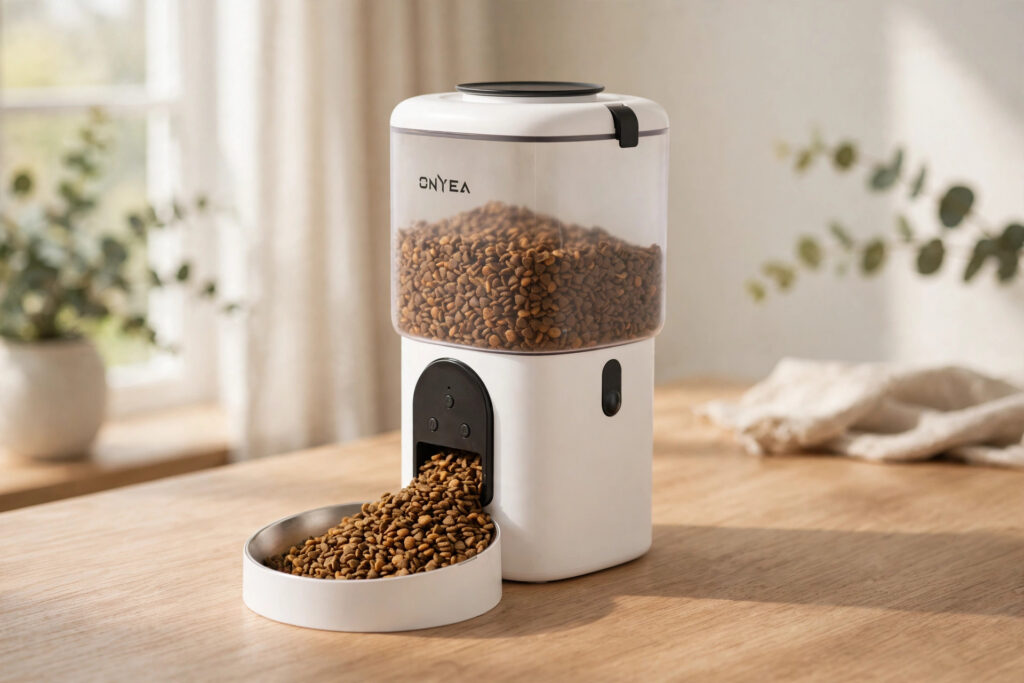
Our feeders run on the same Model PC-F8 platform: 4.5 litres of dry food, a separate 2.5 litre water reservoir, up to 10 meals a day, and IP42 splash protection. The cleaning routine above fits both the Basic and the Wi-Fi models. The difference is only in scheduling. The Basic uses buttons on the unit, and the Wi-Fi model works through the Smart Life app. Whichever you have, keep the base dry, wash only the parts the manual lists as removable, and run the portion weighing test again after a deep clean. If you have not weighed a portion yet, here is how: How to Measure Portions from an Automatic Cat Feeder. And if you are still setting up the routine itself, start here: Smart Feeders 101: Building a Healthy Feeding Routine.
Frequently asked questions
Q: How often should I clean an automatic feeder?
A: Wash the bowl every day or two, brush the chute weekly, and do a full teardown wash every one to two weeks. Wet food feeders need cleaning after every meal, or at least once a day.
Q: Can I put feeder parts in the dishwasher?
A: Only if your manual says so. It varies a lot between models. When in doubt, hand wash in warm soapy water.
Q: Why does my fountain get slimy again three days after cleaning?
A: Because the pump was never opened. The impeller chamber and tubing hold the colony that reseeds the water. Take the pump apart at every full clean.
Q: Is vinegar safe for cleaning a fountain?
A: A one to one white vinegar and water soak is widely used for mineral scale on non-electrical parts. Rinse everything well afterwards so no vinegar smell lingers, and follow your manual.
Q: My cat stopped using the feeder after I cleaned it. What happened?
A: Usually soap residue, or a part that was put back damp. Rinse twice, dry fully, and run a test feed before you rely on it again.
Sources
- FDA, Tips for Safe Handling of Pet Food and Treats, and Proper Storage of Pet Food and Treats (cited in the existing ONYEABLUZ portions article).
- How to Clean an Automatic Pet Feeder, and How Often
- How to Clean an Automatic Pet Feeder Hopper and Its Chute
- Clean an Automatic Pet Feeder
- How to Clean a Cat Fountain: Stop the Slime
- How to Clean a Cat Water Fountain: The 2026 Step-by-Step Routine
- How to Clean a Cat Water Fountain (2026 Guide)